《回忆》/ "In Memoriam"
Reminder: The following travel account was written by AI, and the extent that meaning should be taken from its recollection should be judged accordingly.
We embarked first on our trip by taking the winding grey road that cut through the woods and the old granite deposits that still could remember the mountains of ice that carved it up and covered it up and flowed in its own meandering pace, forming eskers, deposits, leaving stones and scratches. The highway was the Mass Pike, maybe named for the swimming motion it made through the green waters of Massachusetts, maybe for the piercing and slicing motions that had borne it into being.
Driving is slow, but I can't say that I was particularly exhausted by it. I couldn't recall if I had been on the Mass Pike before. My family did not have the necessary blue tint in our blood to go to West Mass. The name and idea were still quite popular, and my 7 year friends would often reference the place, almost as if a wonderland had existed merely two hours away on a boat ride on that grey river. The main reason we had decided to travel was that this was the end of our senior year, so we needed to make sure we made some last memories. Also, Oscar had spent the past couple of weeks slowly diluting my Instagram DMs with camper vans, tents, sunrises, sunsets, and the joys of vicarious views and facsimile forests.
Oscar and Gabe joined me on this journey, and we entertained ourselves with the Hamilton soundtrack. Gabe refrained from singing, and Oscar and I mumbled our way through half-forgotten lyrics. Gabe's phone was on the dash, which meant for the most part Gabe navigated. Oscar had been offended by my assumption that he would have been taking photos during the entire trip. He didn't like how people would often ruin the experience of a moment with a digital memory which was very often never revisited. Every time afterwards that we saw a nice view, an emotional moment, or a scenic memory, Gabe and I said that Oscar should take a photo.
On the trip I brought certain models, those of a Spinosaurus [Spinosaurus aegyptiacus], an American Alligator [Alligator mississippiensis], an American Crocodile [Crocodylus acutus], a Florida Manatee [Trichechus manatus], and a Columbian Mammoth [Mammuthus columbi]. The two crocodilians I had painted, and the others I had not yet done so. Now, I have painted them all. They sat in the front seat, while Oscar and Gabe were together in the backseat.
Our first day, we got to the city of Great Barrington, which in reality was two main roads and 20 minutes of parking lots with stores at their borders. Our first stop was a Bish-Bash-Bash-Bish Falls. The road we drove down to get to the falls seemed like it had been left among the woods for five years too long. The dirt made the car bounce unsteadily on her suspension, and I gritted my teeth because I worried that playing Mitski for her would cause her to give up.
We stopped at the first spot of parking we saw, which was a little dirt patch in the woods. I changed my teal converse high tops for my hiking boots. Gabe figured out that the real parking lot was only two minutes ahead. We drove and stopped.
The water rushed down around one large grey boulder, beneath its blue shadows and yellow highlighted top. The green leaf-lights shone down on the rock's crumbled exterior, softening the grains within its granite crust. Ferric oxides that sprawled and scrawled orange rust lines across its aged faces. The boulder was perched precariously by the father of the father of the father of the water now rushing past and shaping its sides.
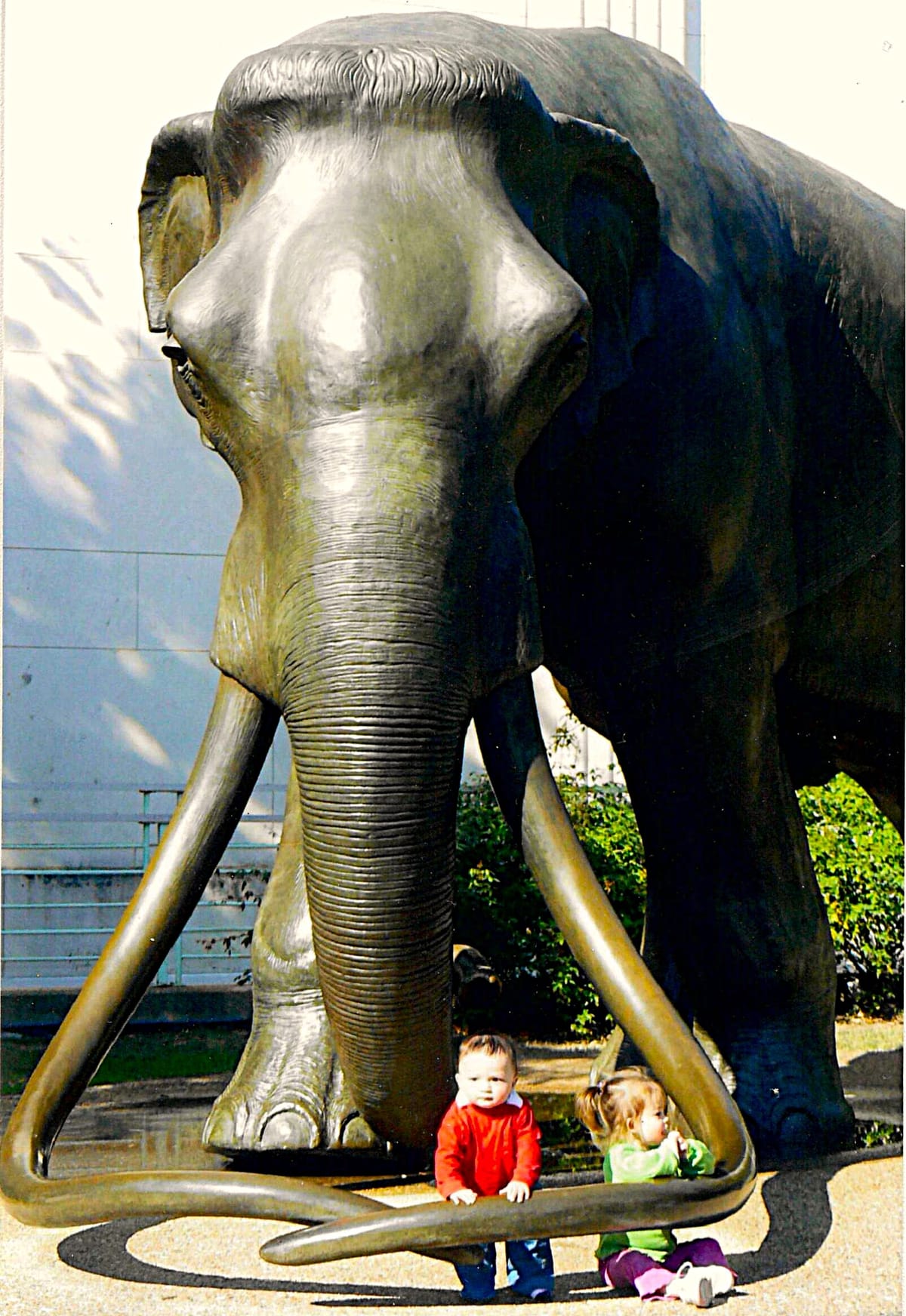
I wondered, as I sat on another meticulously placed rock by the edge of the pool formed by the waterfall, whether or not the land still remembers. The Columbian Mammoth once roamed all across the American landscape. The species had seen countless other creatures, having gone coast to coast along a ghostly soon-to-be Mason-Dixon line, and as far south as the land bridge that joined the two Americas. The species' range did not include the border between New York and Massachusetts, but I did wonder if a wayward male ever did meander his way up to see the very same falls that I was now seeing. Mammoths used to frequent my birth state of Texas. I remembered the large bronze statues that I grew up around, their great tusks and trunks.
I wondered about the people who had, like me, climbed down the slope of the valley, stooped on the rock, and marveled at the glorious sculpting tool that formed the rock around it. Perhaps they lived lives in a small enough world to have seen a large lumbering tan beast and the flashing lights that danced in the spray that crashed against the rocks. Maybe old men would tell tales of their days running and hunting in the hills before stumbling upon a mountain of rippling grey sinew and pink muscle that was scratching the great ribs protruding from its face or the dusty coat that covered its back.
I once rode an Asian Elephant [Elephas maximus] at my local science museum in Lubbock. I still remember it being like a living, animate boulder, one that wasn't too warm to the touch, with coarse, bristly hair under a rough red rug. I can't tell anymore if I thought it was big because I was smaller then, or if in tracing the paths of neurons in my grey matter the elephant grew to sizes rivalling the mûmakil or Paleoloxodon namadicus of old.
Oscar and Gabe and I played 20 questions. We played variations with charades, we made teams, we found ways to entertain ourselves because we couldn't bear to sit for hours in the warm sun, lying on our backs with our eyes to the blue skies and turquoise-teal waters, and think. I chose 'Columbian Mammoth' repeatedly, hopefully to never allow them to forget.
After the waterfall, we figured that we had some time that was enough for something but not enough for an event. So, we decided to go watch a movie. We decided to watch the Backrooms, which I had seen the evening before, and Oscar had planned to watch with a friend from when he could recite each level's qualities. Gabe was indifferent, having neither the experience with the fandom nor the movie.
So, we drove up north to see the movie. Our new destination was Pittsfield, one of the largest cities along the western border, which was about 40 minutes away from our hotel and two towns over. We drove through Stockbridge, then passed Lee, before we found ourselves on a road with multiple lanes.
We had booked the tickets ahead of time, but unfortunately Gabe forgot the two-letter abbreviation for Massachusetts. That meant that we now had about two hours of free time on our hands. We sat down at a bench in a small circular park and watched the light grow from yellow to gold to orange. I took some photos of the sun setting on the ancient pair of the American Alligator and Columbian Mammoth, two species who now had not an encounter for thousands of years. Somewhere deep down inside the archosaurian brain of some gator in a Floridian swamp, there must still existed a neuron, an instinct, a nucleotide, something that was left of the long-nosed hairy giants that roamed the valleys and mountains and mires and meadows.
Oscar decided to quest for the YMCA, and Gabe led me, looking for a bookstore. Unfortunately, Pittsfield had already forgotten it, because the supposed location of the bookstore was now taken over by a sprawling pizza shop. As Gabe and I walked along the streets, though, we got the uncanny sense that something was not right in the town. We passed by two or three nursing homes, and the vast majority of the residents we watched walk around had been walking these same streets for years before hand, weathered by winds that had now cooled.
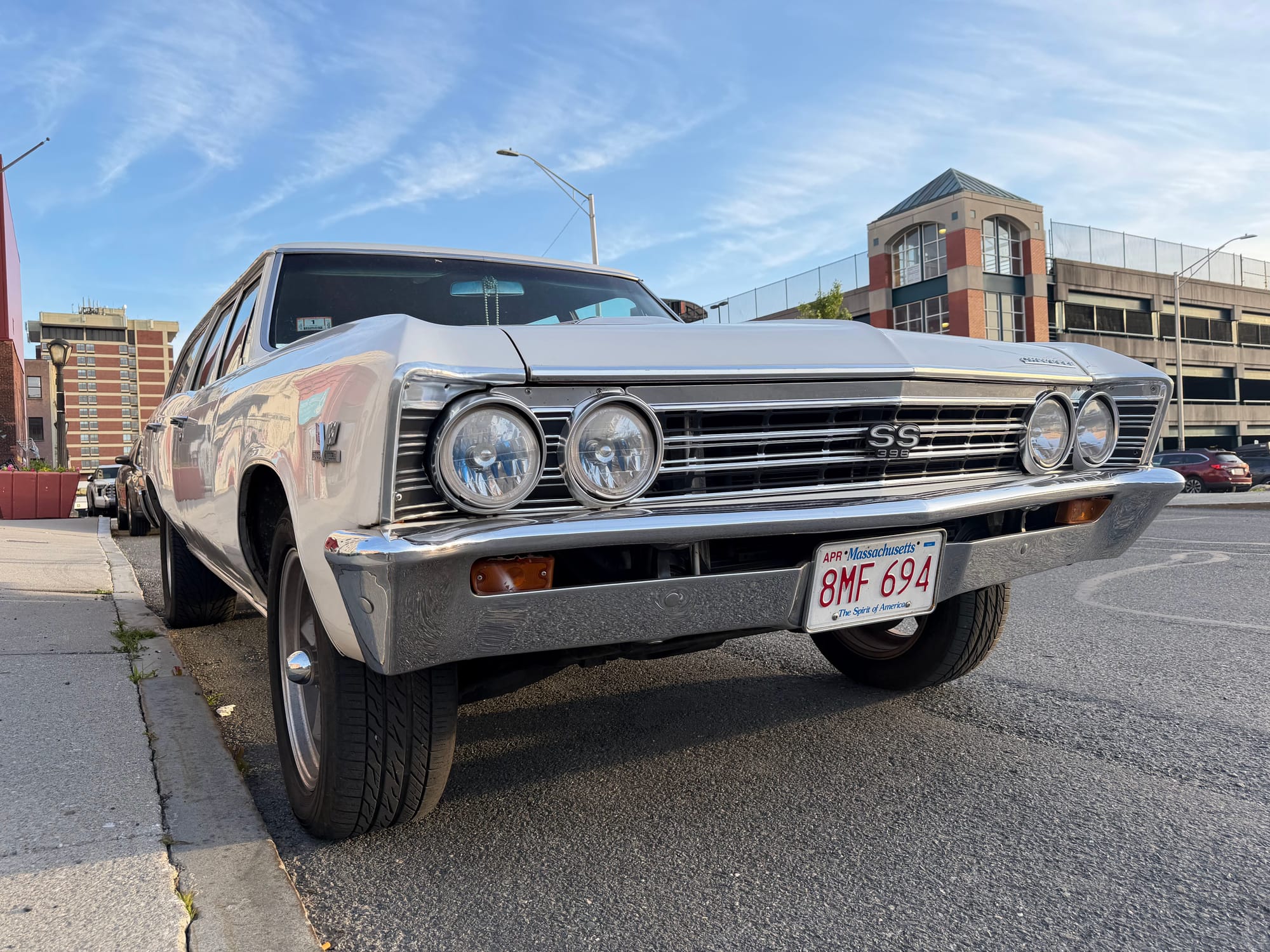
We passed a car parked absentmindedly by the road, a boxy white car. It looked like many of the various now-40-going-on-50-year-old cars that we passed by in Quincy, or one of the older Soviet-era cars that drove the dusty streets of 台安. I didn't recognize it as any make of car I knew at first, and it seemed to me like some combination of a station wagon and a lincoln.
We ate dinner at an Indian restaurant in a small apartment or mall. I'm not sure what the place was; It was the strange melding of the two. As we left, Gabe and I watched a bird trapped in the strange structure fluttering against a window.
"I was touched by a kind of pity when I saw the two rooms emptied at last. The little building that for thirty-two years had been as familiar to me as my own clothes now looked as if neither I nor anybody had ever lived there. Separated from the daily human life that have been lived in it, it looked almost unbearably flimsy and temporary and inadequate and purposeless and poor: "Ye must be born again." I took Barber Horsefield's paper clock whose hands always pointed to 6:30, wrote GONE on the back of it, and hung it up once more in the window."
- Jayber Crow [Wendell Berry] in "Jayber Crow"
After the movie was over, the ghost town was eerier than ever. Now, the lack of even the elderly made the darkness loom greater. Our Black Tiguan was the only car parked along the road. The emptiness of the town put upon me a strange ghastly melancholy. It felt as if the town was waiting for travelers who would never come, burdened by the weight of the inhabitants who were increasingly no longer there. The road stretched on into the inky, murky, black darkness, a face of sheer black, like the asphalt and gravel had been reduced to the basic geometry of a plane, no longer three-dimensional but two. A greying memory bubbled up of wandering the lonely, dark, and foggy highways of Saint John with my parents, hearing snippets of laughter from someone above adding to the smoky particles in the air, trying desperately to find the warm lights of the Tims that we saw very clearly across the great highway that we had no way of crossing.
Oscar had told us earlier of a word, κενόψία [kenopsia], when we had stopped at the Lee Premium Outlets. There, the bright pastel of the buildings paired with the emptied parking lot and paucity of people made us feel similarly out of place, again, like the structures were made for nonexistent people. They were waiting. We first wanted to watch the movie when we were accosted by that uncanny feeling and thought of it.
Oscar later told us that every time he went to sleep, he would see the Captain's face. I, still, can't forget it. As higher quality images come out as the weeks since the movie tick by, I keep waiting for the sting to dull.
The second day, we drove north, through Stockbridge, Lee, Pittsfield, all the way to Mount Greylock, close to the New Hampshire border. We stopped first for breakfast, where Oscar got the french toast which he had been lamenting not getting. I noted the شَكْشُوكَة [shakshuka] a tomato and egg dish that was a lot like a Chinese 西红柿拌鸡蛋,which Mr. عثمان had made in nearly 5 minutes during Trinity Term and tasted better than an hour.
The drive up to Mount Greylock took an hour. We listened to a series of discipleship classes that were given by my pastor over a year before. Oscar had been asking questions on day 1 relating to apologetics, the historicity of scriptures, and literal compared to literary readings of the Bible.
We had woken up later than we had planned to, so we got to the mountain around early afternoon. The sun was still balmy, having just been hot. As we hiked up, we played similar games that played on our reflexes and memories. The hike had been much steeper than we expected, and we talked to keep our minds off of the pain. Occasionally, I would toss a glance at Gabe to see how far we had hiked. The hike was supposedly merely 3 miles, which we expected to climb faster than we did. At 1 mile up, we had stopped playing our games and just talked as much as we could.
Halfway up the hike, we saw a small wooden hut, one that looked like it fell between the gap of cozy and creepy. We sat and talked for much much longer. Eventually, we started talking about the video games we liked as kids. We started guessing them again, and eventually that evolved into playing 20 questions. We started walking again after a couple rounds.
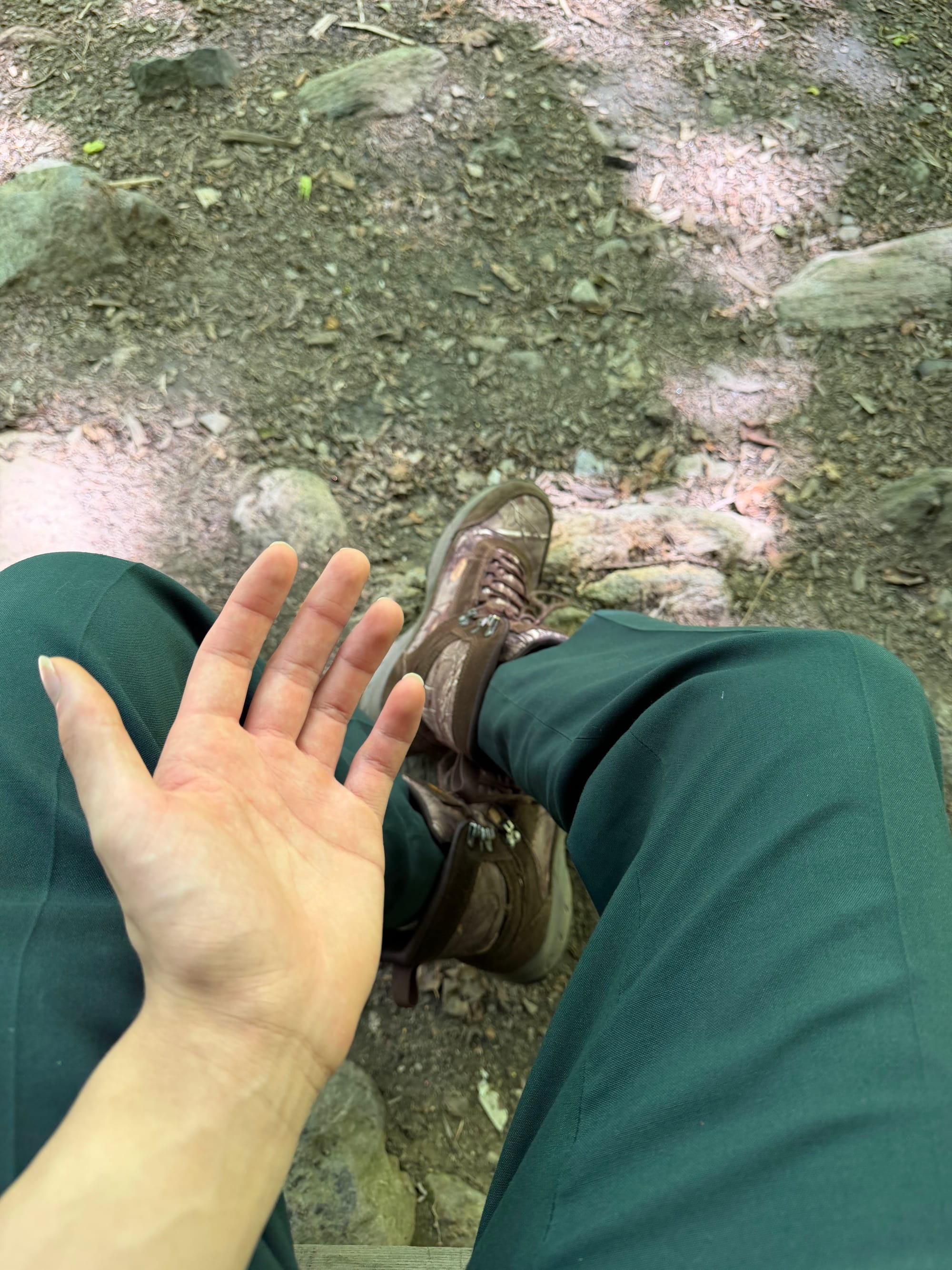
During the next section, the hike got increasingly hotter, as the foliage that covered us slowly rolled back to reveal the view and the sun to us. The ground became sections of mud or sections of stone. My mind contained "nicher, artsier" games, and unfortunately that meant that 20 questions became 30 or 50. We came upon a small set of stone steps and a long stretch of grey pavement. We could guess that we were getting closer to the top, but we couldn't see the peak yet.
Thankfully, the zenith was only through a few stands of trees and a parking lot. The top of the mountain had a large tower that was hidden from the road, one that memorialized veterans and overlooked three states and multiple mountains. The interior was eerily kenopsic, but the top was air-conditioned, with a guarded glass view of the landscape. We spent some time in there cooling off, washing our faces of the sweat and grime and pain.
We sat outside on the grass, as the soft sun shone, eating sushi, and enjoying the view. I read my book, Oscar listened to Noah Kahan, and Gabe joined him. Oscar only took a few pictures. We could see little cars sailing across the grey-blue expanse, off on their own journeys and trips. We sat and watched the world slowly rotating above us, as the grass softly rustled, as people walked by, as, on the top of the mountain, in the wonderful little garden of wildflowers, soft reeds, and tall grass, Western Mass slowly etched numerous numinous images into our minds.
We again had an awkward amount of time to kill after the mountaintop. We decided to watch another movie, rushing down the mountain, trying our best to make it to a screening of "The Sheep Detective" back in Great Barrington. We were going to be late, but we didn't know how late.
During the hike down, Oscar and I slowly encircled around arguments of the meaning and use of the word "propaganda." We were back in the shadows cast by the trees overhead, long past the peak of the mountain. Oscar had sent me a reel of the Catholic Church, one that shone a light into the soft and tender part of your heart, which Oscar decided to call "propaganda." I objected to that usage, thinking it too vulgar to be used for something decidedly wholesome.
However, Oscar had been right, but not in the way either of us expected. The word that had formerly meant the spreading shining light of a Catholic Church's works, which now had the grit and blear of death and The War and The World, had found its original use again.
Oscar agreed that there were better words, like advocacy, that captured the sense of biased or intentioned media he was hoping for. We walked out of the trail and into the sunlight, down the dirt paths and into the parking lot, and we drove away to a movie we were going to be late to.
During the drive, the sun bathed the landscape in golden washes, the lakes and mountains reveling in their gloaming glory. Gabe and I told Oscar to take a photo.
After the movie, we decided to go eat. It was now well into the night hours, there were no longer cars parked alongside the dusky roads, and fluffy clouds drifted dreamily across a hazy moon-lit sky. Oscar looked up some restaurant that he thought looked good, and I neglected to tell him that he chose a bar. I assumed he knew well enough what he was getting into. He did not.
It took a good ten minutes after we got the menus, on which a poem about borders and colours and childhood was written, before Oscar realized we had walked into a bar. He decided that he did not like the bar, and he declared emphatically that he would never return to a bar unless he were to get "absolutely hammered." He was proud that he was green enough not to have experience in bars and headstrongly acted accordingly. Gabe and I murmured our appreciation of the atmosphere and took some photos. I stole the menu as a memento.
On the drive back, I drove Oscar to get a set of 10 piece chicken nuggies. He hadn't gotten enough to eat, and he certainly was going to need it. He had ordered a single charcuterie board. We drove there and back again to the hotel. This was the night I slept on the floor.
The next day, Gabe and I had our fun, because we were going to the Norman Rockwell Museum. After two days of hiking, this was the day reserved for all the artsy events. While driving over, we finished the last discipleship class recording, one on the ANE cultural river. I'm not sure how much Oscar listened to, and I'm less sure of how much he remembered. His question, whether the gospels could be reliable given the time they were written, the age of the manuscripts we had, their authors, apparently remained unanswered. He asked me the question again a month later. I hope he remembered that time, but I'm still not sure. I thought it strange that it'd be so easy to forget.
We drove to the neighboring Stockbridge, where we found ourselves on a small estate, a simple white house with two other buildings set atop a manicured green lawn in a circular clearing between the lush woods.
We parked, we walked up to-
Oh. I forgot.
While we were eating breakfast, I decided to get a matcha latte. I figured it was sufficiently funny as a joke, considering how averse to the "artistic" Oscar was, and considering we had now gone to multiple cafes, diners, and a bar that had the exact vibe which Oscar didn't appreciate.
That day I had decided to wear white jeans, jeans that are quite special to me, considering they were my dad's when he was around my age, and they were blindingly white. He probably never wore them, because otherwise I didn't trust him to maintain that pristine of a condition.
Gabe asked if he could have a drink of my matcha. I didn't like it, considering how watered-down it tasted, and I had been sharing meals with these two for two days now, so I had no objection.
Gabe sipped the drink.
He set it down on the table.
It fell and spilled.
I had just about forgotten that. It was fine. My pants were able to be cleaned pretty thoroughly, thought I had suffered a mild bit of embarrassment from trying to hide a yellowish stain along my back left leg. It was washed away, washed clean and white as snow.
I'll try better to remember now.
In the museum, there were a series of rooms, with a series of paintings, and each room had a different series of paintings, and colours, and themes. There were paintings famous in the American zeitgeist, paintings about The War, The Other War, the Civil War, the civil rights, and on and on. The story being told by the museum was interesting. It wasn't the immediate image you thought when you considered Norman Rockwell. To be fair, there was a lack of Norman Rockwell in the rooms.
There was one, rotunda, I suppose, that housed the Four Freedoms Paintings. I had first encountered them when I saw a print of Speech in my 8th grade English teacher's classroom. I couldn't have told you a thing about the painting, but it looked nice, and it followed me in my mind ever since.
This room was mostly bare, being four paintings, four benches, four doorways, and a heavy, rotund emptiness in the centre of it all. The paintings were housed like a jewel, inset into a circular frame, every other room and piece spreading away like bands of silver and gold, with all the attention on these four paintings. The room felt a bit dim. Adjacent rooms housed Uncle Sam pointing at you, Liberties cut or wading, waterfalls overflowing with words, poetry, language.
I looked at the Speech painting again. Behind those eyes was now Abraham Lincoln, or George Bush, or some US President more than a New England farmer. The silver was tarnished and the jewels were scratched, and years of visiting and reiterating hadn't polished them like the wear on bronze statues, but frosted them over with things, patinas, artefacts. I felt I could see the film grain or the pixels instead of the brush strokes now.
We left the museum and got back to where the hotel was, on the outskirts of Great Barrington, I believe, and we took a right after the hotel, pulling into the parking lot of an Asian store that had piqued my interest given our repeated passing. The large metal Asian dragon was pretty recognizable considering the sheer difference from the surrounding architecture. Right outside, there was a metal crocodilian, labelled as a "Croc," incognizant of the species of Crocodylus or Alligator of the Asian countries of the store's artefacts.
Inside, the Asian store's decor was maximalist, with ox bone ivory sculptures, filipino dolphin wood carvings, and gods, goddesses, bodhisattvas, buddhas, guardians, demons, heavenly beings of all sorts. The deep rich browns of the cabinets and the bright red, black, and white pigments had been bleached, either by the warm sun of a couple decades or the few months in the musty florescent light. The first room we entered was stacked so high and full that we were convinced it was impossible that one could ever collect so many things of so much value and sell them for so so low of costs. So, there we stood.
The signs written on bright neon cardstock or pastel post-its that were stuck and taped and attached to the various statues screamed the deals that were offered, the idols and shrines that had been brought to these burgeoning shelves of carved and painted worshippers. The bulging eyes of a garuda leered next to the wispy beards of daoist deities and hanging pink lanterns with pinpricks of light shining through the holes in the paper, the indonesian nude male of varnished brown skin standing in a picture frame loomed over acupuncture posters I could swear I walked by on the street in suzhou, and placards boasted the Real Handcrafted Gold-Gilded Asian Shrine right next to you and urged you not to sit on the Shrine that now sat laden beneath two gongs without a hammer. Antique, not ancient, but Antique japanese scrolls of calligraphy in swooping lines hung on white wire racks next to a surrealist monochrome nude of a writhing flamingo-pose female and some figure hefting a dead body over a grey, shadowed shoulder. Deep dirt yellows shone from the paper and wood that covered the walls, and light, dusted, light-dusted wooden frames showed photos of previous purchases, buyers, and happy customers. An empty breastplate made of hemp and clamshells stood proudly over a dragon's horde of fairies and fiends. The Antique power emanated from the many-limbed, many-horned, adorned gods that stood like wood looking at us from their perches.
Gabe and I walked outside for some new air. We walked around the side of the building, where larger statues stood in a strange arrangement for a cemetery, an american bison forever glancing at some odd number of doggish lions. The sun was not kind to these foreign statues, lifted from their bases, placed in the maws of immense cargo ships, and brought to the bleached hills of Western Mass.
I walked over to a series of ashen-grey slabs that leaned listlessly against the wall. They were headstones. They used to be Chinese workers in Jakarta. The name on them was 郭。
I've seen the same name on another stone, this one not from Indonesia but from 台安. It wasn't taller than it was wide or long, but a trapezoid that jutted out like a defect of the geometry of a concrete base that stretched along a sullen river bank. 郭树军 it said, and 魏会莲 beside it. Two tiers of grey stone slab was placed and sealed with grimy grey silicone atop a dark hole that concealed grey ashes. It had sharp edges, was carved from whatever leftover material that wasn't being used for another doufu tower or another statue doomed to be taken down before a patina grew on it. It was bolted and glued and sealed shut, and there was no opening it up again. A one way door. I had placed my hand on it, and it wouldn't budge.
郭 means the stone walls surrounding a city, the bastion, the guardian, the protection. Nowadays, its namesake is probably long gone, decayed by the rushing of time, the scrabbling hands of workers building new walls, or merely buried under shifting soil. Perhaps, one of those stones had gone from 山东 and made it to 台安, where an empty family's name could be carved into its thick shell, and where it would be left to be shaped by the rustling winds through the rare stands of trees amidst corn and rice fields.
The deadened, silent stone now stays there, otherwise memorialized around the world in two pear trees, a hundred or so pictures or recordings, some loose belongings, a scrawled inscription on the wooden slat of a raised bed, some arrangements of neurons, and a handful of tearful responses to an old song about home.
”这封信是外公落笔当下的心智地图,一座布局模糊的记忆迷宫。时光在纸上敛缩,褪去,只为了以脱节失序的姿态再次现身。不眍的时间是不是在他生病的时分层了?或许那些岁月被压扁,折叠一个由众多片段组成的时刻,就像我记在心里的字词和地名一样,多种语言不断流动。他的回忆究竟是同时存在,还是完全不存在?
读信过程中,我不时感觉到他潦草笔迹下蔓生的文字枝桠亟欲往外生长,深入空白。可是他的书写愈来愈混乱,接着骤然停止。 "
- 李洁珂,《山与林的深处》
"The letter was a map of his mind then, a labyrinthine thing of memory. Geographies blurred. Time shrank and receded in its pages, only to emerge once more, disjointed. I wondered if, in his illness, time had layered. Perhaps it was flattened and folded into a single, multitudinous moment, the same way I carried words and places in my mind at once, multi-lingual and moving. In the end, did his memories exist together - conceptually - or not at all?
Reading, I felt at times in the spray of its branches - rows of characters overgrown in the wildness of his script - longing to emerge into a clearing. But his confusion thickened. And then, abruptly, it ceased."
- Jessica Lee in Two Trees Make a Forest
I wondered about the worker, this 郭先生, this Mr. 郭, who must have travelled due to the Western takeover of the 清 or the various governments that swept the landscape since, having sat somewhere on the edge of a field, or the floor of a factory, or the seat of a chair in a small house. I wondered if he had sat, thinking about the path his string had taken him, and if he had expected a death away from home, wondered if he had expected his final resting place to change, to be reinterred in some pigeon house, expected to lose his headstone to either a construction project or outside a warehouse of a peddler of yard decorations, seen only half the year when people so unlike his family decided to stay for a break from their menial jobs. I hoped he had not ever realized his rest could be so disturbed.
The headstone wasn't for sale. Good. I wasn't going to buy some 郭公 on a stick with white glass eyes, matted white fur atop its head, and a sewn mouth.
We no longer had the money to go to another movie. We decided to frugally spend the rest of the day sitting in the hotel room, having nothing to do.
At night, we ate McDonalds, as it was the cheapest option, preserving funds for potential gas refills tomorrow. I played games on Gabe's computer, and Oscar and Gabe sat on the other side of the room playing games, though I don't remember how. Later, after dinner, we play a short oneshot game of D&D, introducing Gabe to the concept of sitting around while his teammate is swarmed by Stymphalian birds. They both played characters from sheets that I had lying around in my binder and makeshift screen, characters that were left behind, forgotten or remaining ghostly images dancing through the thoughts of players and friends who had walked onward on paths following strings that I couldn't recall. Gabe played a purple half-dragon, and Oscar played a wizard. I remember them having fun, but our energy was slowly carried out the door and past the inn, and our fun slowly petered out.
The next day, we got ready, checked out of our hotel, got one more breakfast from the cafe we previously went to. I got the شَكْشُوكَة. It wasn't as good as I remembered Mr. عثمان's was. We got in the car, and we drove off, watching the small white shapes of the houses slowly sail away behind the rolling waves of hills and mountains. Oscar and I had been talking about a show, Plur1bus, which had piqued his interest as something that was intellectual and entertaining. We drove on, listening to Wheatus and the Oh Hellos, Oscar trying to watch the show on his laptop as it refused to load.
About 2 hours into the drive back to our eastern homes, I got cocky. We were sailing down the waters of Mass Pike, listening to each other's songs, seeing who could draw a song out of their memory that the other didn't know. I was driving down hill and watched the number on the speedometre crawl up past 60, then 70. Once, I had gone with some friends, Χριστόφορος and ໂພນສະຫວັນ, with my dad to see some tribute cars from Back to the Future, which sat their haunches down in a garage on the border of Massachusetts and New Hampshire. I remembered the collector having said that once he had gone up to 88 miles per hour on a largely deserted road, and I decided to try it out. I figured I wouldn't always get a chance, and I was with friends, so I should make some memories. I remained firmly in my position in the fourth dimension and slowly the Tiguan slowed the number down to around 60.
About a minute later, A bright red-orange oil pressure light shined on the dash, and a loud beep struck horrible chaos in my heart. My car was having some trouble. The heat was getting to her; the AC, driving, and high speeds were too much for it while driving downhill. The show still wasn't loading. I frantically asked Gabe to navigate our way to the nearest rest stop. The rapids of the Mass Pike apparently didn't have many rest stops, and we hoped and prayed for some exit soon. About 6 minutes later, she pulled into a McDonalds parking lot as I could hear the whirring groans of the fan cooling the engine down. Gabe and Oscar went inside as I dialed my dad.
The downhill caused too much oil to rush to her head.
We decided to wait a bit with the heat and try again. Using the McDonalds' wifi, Oscar and Gabe got the show to load. We sat and watched for about 30 minutes. Don Quixote and Sancho Panza got some food, as we hadn't had lunch yet, so I decided to get some too.
I tried the car again, and she cooperated, and we drove back onto Mass Pike.
About 20 minutes later, and still about 3 hours away west of home, the car started whining again. We stopped again, called again, got snacks again, and tried again. This time, we were advised to stay off Mass Pike's rushing speeds and drift down some grey parkways that webbed their ways throughout most of the increasingly urban area. We got off around Southborough and slowly got on our way, trying our best to ease the car through the rest of the hot drive back.
Plur1bus seemed to delight Oscar a lot, and I could tell that Gabe was also pretty interested. I myself felt twists in my stomach as I tried to make our way back home. Carol Sturka drove through the chaotic Albuquerque roads, horrified by the red glow of fire and the orange sparks coming off of the streetlight that a police officer had crashed into. We were going to be much later than we expected, which we realized as we saw the golden glow of the sun as we raced in opposite directions to our warm dark beds. The light didn't blink again, nor did the Tiguan complain in her loud bleating voice, but my hands clenched the steering wheel the whole way back.
Oscar couldn't understand why exactly the World in the show was able to do the things it could. I told him that if the whole world was bent upon the whims and wishes of a single person, what couldn't it do? He interrogated the World's ability to combine all abilities, demanding to know why certain skills like flying a plane or driving a car were universal, and the show itself explained how the memories combined between the individuals was what allowed the Unity to form.
We pulled into a grocery store parking lot, and Oscar and I said our farewells to Gabe. His family wanted him home early, and his house was somewhat on the way back, so we dropped him off. He pulled his suitcase into the trunk of his family's car, and his mom gave Oscar and me drinks as they took him home. Oscar too would have gone, if I hadn't been unsure about my ability to navigate home.
We were lost for a bit as Oscar finagled with his phone, because our navigator had been taken. Oscar and I then drove past Holy Name, then Connell Field, then our school. We hadn't expected to see it again so soon.
30 minutes later, the Black Tiguan crawled, panting, into my driveway, and Oscar's mom took him home, and I was alone.
"I realized then that a man who had lived only one day could easily live for a hundred years in prison. He would have enough memories to keep him from being bored. In a way, it was an advantage."
- Albert Camus en L'Étranger
Two months passed, and I was walking away from the T station after work. My feet trod upon a tan sidewalk beside the grey road that led to the highway as I watched the forms of the brownstone office building and the golden dome of the Adams family tomb. I thought about the afternoon I had had. I had been working with youth when I had been accosted by a sudden flood of memories. The whole day I was inundated with the sights of ghostly images around me. There was a certain way that people said 'thank you,' a way that people laughed, a way that people hugged, a way that people smiled, a way that people tugged at my heartstrings that reminded me of familiar hands that used to pull at those same cardiovascular threads. The last I had seen of anyone from that little Catholic orphanage in Hyde Park had been the day I dropped Gabe off in a grocery store supermarket and the day Oscar got out of my car in my driveway. I had known a year up to that point that I was going to say my last words as a living member of that corpus, and I had made a show of my goodbyes. It was, however, when I sat on a fountain step outside a large ornate library across from a shaded cathedral that I finally placed a hand on the shoulder of my grief.
I got to the parking lot of my church and got into my Black Tiguan. Her bright tan pleather seats beamed with reflected sunlight at me. The warmth inside felt like a thick coagulant that stuck to my skin with a constant sensation. As I drove through the winding road through Quincy Centre, I felt the sweat slowly seeping down my forehead and into my eyes. My eyelids closed with a heat that made each blink spring up rolling magmatic tears to cool my irises. The grey Subaru in front of me drove quickly through the centre and faced the road past the high school and the Y. Its blinking stars on the navy-blue field shined smiles in the sun. The world was changing now. I could feel it, both in the asphalt, the concrete, the lyme, the brick, the clay, the mud, the silt, the sand, the soil.
"乡土社会在地方性的限制下成了生于斯、死于斯的社会。常态的生活是终老是乡。假如在一个村子里的人都是这样的话,在人和人的关系上也就发生了一种特色,每个孩子都是在人家眼中看着长大的,在孩子眼里周围的人也是从小就看惯的。"
- 费孝通,〈乡土本色〉
"In Chinese rural society, people are bound to the soil from birth to death, and their relationships with one another grow out of this shared, immutable ground."
- Fei Xiaotong, From the Soil
We drove past the centre and down the hill towards the high school. The star-studded car balked at the speed of the grey Tiguan stopping for a YMCA camp leader and swerved around her, before he drove through the blazing red lights above the intersection. The man behind the steering wheel of the grey Tiguan swirled his finger in the air to the heat-oppressed whims of the Pleiades rider. I took a left, pulled into my driveway, and thought about the faces that I would never see all together again, except in the wavy mirages above the hot bitumen surface.
I wish sometimes I could dispel memories, drug them into a stupor, or if it came to it, cut them and splatter their grey blood about the walls of my mind. At least then I could appreciate driving alone.
“If I find in myself a desire which no experience in this world can satisfy, the most probable explanation is that I was made for another world.”
- C. S. Lewis in Mere Christianity
Humans are migratory creatures, our whole species' lifetime defined by the constant migration outward from the valley where we originated. We've gone out north to Europe, East through Asia, the Polynesian Islands and through the Americas. We have lived to sustain and fulfill that endless drive forward. The result, however, has been that many of us have been left behind by those migrations. The result of an endless drive forward is a feeling of loss and lack of belonging, because we had originally left our Garden homes, left Ur to find Israel, left China to Singapore, Indonesia, the US, and we have uprooted ourselves, shifted the riverbeds to a place that never perfectly fits who we are. We rush forward with the tides, we try to paddle backwards, we try to tread water to find our homes, but we will not find it.
I thought back to the residents of Pittsfield, a town that seemed lonely and burdened with age. Maybe, they had escaped to the source of Mass Pike after having spent years watching the large grey trees of Boston and New York grow taller and taller until they could no longer see the yellow sun painting purples on the blue sky, until all they could see was a red sun's harsh orange against the black shapes, with dim red lights blinking in little pinpricks. Perhaps, they too, had become tired of the rush of the grey waters that seemed to propel the New England north, to remember the colours of the world, the blue-greys of water and pink-greys of mammoths and purple greys of sunset shadows and green-greys of rocks. Perhaps they wanted to remember that where we came from the greys were there to brighten the other colours, to help us see the beauty of the blue shadows and green leaves, to highlight the red and yellow flowers and to raise up to our gazes the orange stones that we'd use to help build our homes and forge our tools.
Even better, in those small green towns in the shallows of the grey rivers, we could remember how we first got there, as molecules of water in a rushing migration that went east. Had that endless tide of human exploration not been stuck in bays and eddies, coalescing into agriculture, villages, towns, cities, that water would rush around the world in a ring, wrapping around the earth in ever flowing, yet stagnant water. If that flow were permitted to continue, that human drive, the force would slow and slow, yet slower and yet slower, and it would eventually become dead water.
The fact is, we were not made for the world we ran to find. When people recognize this, they scramble desperately to mould water into familiar ghostly shapes. They try to make the World into their image, trying to find some semblance of belonging. Others try to make themselves into something of this World. Eventually, they collapse and feel the water passing over them. Maybe finally, they stretch their red hands out to find their home.
I was driving again on that grey road, taking ໂພນສະຫວັນ down from New Hampshire, where we had visited Χριστόφορος. We were driving along Route 2, taking my Black Tiguan. I was worried she'd have an issue, as this was the longest she had spent on the highway since our fateful westward journey, but she had no issue. We were listening to Come Back To Me, and she was happily rocking along to the bass and drums and guitars with ໂພນສະຫວັນ.
I had been nervous because I didn't like driving much, and I certainly didn't want another stressful situation where I would have to deal with a whiny car and a messed up oil sensor. I was likewise tired of the fast-paced rushing of the Mass Pike, its jaws like its namesake or worse like Jonah's whale. I was tired of driving around great big trucks and SUVs that hauled nothing on their wide backs and saw nothing through their tinted windows, revealed no passengers nor drivers. I wanted to remember the part that had made me enjoy driving in the first place, the cautious steps through eddies, taming my Black Tiguan in the blue-grey creeks alongside the green banks of the cemeteries and abandoned parking lots. I missed the small waves of bright hands in the windshields when a kind driver calmed their car and let me and my Tiguan pass, despite our small stature. not the crashing waves and 台风 and hurricanes and tsunamis of the massive sprawling highways that leapt over each other to race towards the nearest jungle of concrete and glass we called cities, ignorant of any of the small red brick buildings it demolished in its wake.
This calm Route 2 was a nice change of pace. It was a smaller river that eventually flowed into the Mass Pike and out to sea, and the cars swimming alongside me cared less about their destination and the time it would take to get there. We were enjoying a soft drive back, after lounging around on wooden benches or playing card games during a nice lazy afternoon in rural New Hampshire.
We got on the ramp, and while turning clockwise, the light grew pink. The sun was going down, the tree tops were painted golden, and the road shined a deep purple. The clouds above were soft shades of cream blending into coral and ending in lavender. The New England twilight shone on our eastward road. I told ໂພນສະຫວັນ to take a photo.
Oscar, Gabe, and my families all came ultimately from China. Oscar from 南京, around the delta of the 长江 river delta, Gabe from 重庆, further upriver, and my family east of the 辽 river in 鞍山。Our families had been displaced and uprooted by the routine torrents of Chinese political turmoil, which like the muddy grey-brown river waters rise up every so often to leave the country in political disarray and to shake up the presiding dynasties, republics, or empires. In the aftermath of the flood, my family history was lost. We have some passed down memory that we may have come from 山东,may have been there from other minority groups, but we have no 家谱。My grandparents didn't know their ancestors well, and now with them gone we know nothing of their past.
I only have memories of them, photos, a grandfather clock, and a few knick-knacks. I'm even starting to forget those. My mom remembers some more than me, and my sister, and my cousins and uncles and aunts. My mom also recorded some stories from my 姥爷 on the tiny glowing screens that were the only way to stay in contact with him. Hopefully, we can keep them alive for another few decades.
Oscar had asked me about how we knew the Bible was reliable. I now think back to the Israelites, adrift in exile in Babylon, desperately grasping on to the memories of their temple, cities, families and resolving to write down the Law and the Prophets and the Wisdom that they remembered. It was the only way to keep them tethered to a home in the distant western past. Likewise, I think about John on his little isle of Patmos, remembering the candlelit nights sitting and laughing with his friends, like brothers, and his Teacher. I can imagine him writing in his darkened room in exile, after decades distanced from that, having witnessed a temple destroyed and apostles lost, trying desperately to get his details out before he knew that he too would be resigned to oblivion in the halls of rest. My pastor often referred to the Bible as a family history book. A 家谱。
"I am an old man now and oftentimes I whisper to myself. I have heard myself whispering things that I didn't know I had ever thought. 'Forty years' or 'Fifty years' or 'Sixty years,' I hear myself whispering. My life lengthens. History grows shorter. I remember old men who remembered the Civil War. I have in my mind word-of-mouth memories more than a hundred years old. It is only twenty hundred years since the birth of Christ. Fifteen or Twenty memories such as mine would reach all the way back to the halo-light in the manger at Bethlehem. So few rememberers could sit down together in a small room. They could loaf together in the old poolroom up in Port William and talk all of Saturday night of war and rumors of war."
- Jayber Crow [Wendell Berry] in "Jayber Crow"
I sat at a table in a little Thai restaurant across from my church. I was having lunch with my pastor. We were shooting the breeze, watching the World pass by on its wheels. I will always love shooting the breeze. He asked me about how I was feeling, about the summer, and about my life. I told him about a bittersweetness in the summer. Summer had always been a period in between moments, August especially being the month we moved because of the academic years. 7 Augusts ago, we first landed in a new Northeastern world, 13 Augusts before that in a Chinese Mid-South that would become my first home in the world. I told him how Friday was my last day of work at my job of three years, and how I said goodbye to my sister, who was again leaving for Texas. I told him how this whole summer was a moment where I had to come to terms with the loss of homes and communities.
I knew I had to leave my job, my school, my church, and soon my family. I knew the World was an impermanent place. I didn't feel at home in Massachusetts anyways. But these places had been my little glimpses into an eternal resting place that I would hopefully one day see, and I was sad to have to say goodbye to them. I remember how I used to say that my time at BTA was up, that I had been allotted 7 Augusts and couldn't stay longer, or the labyrinth in its belly would swallow me up. But it still hurts to have to say goodbye.
I told him I was writing a story. I needed some way to try to memorialize my feelings and relationships. They should live on in some way.
I walk over to the East African Okra [Abelmoschus esculentus] planted next to Chinese Peach [Prunus persica] and Pear [Pyrus pyrifolia] trees and New World Tomatoes [Solanum lycopersicum], planted because my Charlestonian father loved eating them deep-fried, and not so much when my mom tried to stir-fry them. I pluck out the Kentucky Bluegrass [Poa pratensis] of dubious origin, trying to nurture the Okra so that we could harvest them before fall.
I've now written more words than there are Augusts separating us from the first proto-writing symbols, more words than memories to reach to the last Interglacial Period. A 3 million year old Blue Jay [Cyanocitta cristata] caws above my down-turned head as I scrabble at the grass. It's yelling at an Eastern Grey Squirrel [Sciurus carolinensis] 2.98 million years its junior. They're both Mass natives.
I can feel the dirt is different now. The Okra grows slower this year than the last.
I walk around back, disturbing a Common Eastern Bumblebee [Bombus impatiens], at the European flowers of a Red Raspberry plant [Rubus idaeus]. I examine the Okra that are now beneath a 冬瓜 vine [Benincasa hispida] and decide that it may be better left alone. I watch the busy road in front of my house, and I open the door to the vestibule, leaving my shoes on the faded Liberty Bell rug, before going inside to my house.